There's a pretty good chance that if you spend enough time around futures prop firms, you've heard about Tradeify's Premier Trading League. And if you haven't, here's the short version.
Tradeify is running a free simulated trading competition with $1 million in advertised cash prizes, head-to-head matchups, two qualifying Opens, and a live championship planned for Fort Lauderdale, Florida. First place at the final is listed at $180,000.
And the best part? You don't have to buy a prop account, pass an evaluation, or risk your own trading capital to participate. Eligibility and verification requirements still apply.
Naturally, I signed up. After competing through the first several matches, I've got some thoughts.
How the Premier Trading League works
The Premier Trading League is a simulated futures trading competition organized by Tradeify. Its competition guide describes Open 1 and Open 2, each with eight matches over four weeks. Matches take place on Tuesdays and Thursdays.
Every match pairs you with another trader. You both start with fresh $50,000 simulated accounts, and the trader with the higher closing P&L wins the matchup. Pretty straightforward, right? Well, there's a little more to it.
You're also collecting points based on trading performance, and those points drive your position on the leaderboard. The tradable products are ES, NQ, GC, and CL, or their micro equivalents. The position limit is one mini contract or ten micros across the entire account, not one of each.
And yes, somehow people are posting absolutely ridiculous simulated numbers with that position limit. We'll get to that.
The scoring system
Here's the scoring Tradeify publishes for each match:
| Match result or P&L | Points |
|---|---|
| Win the head-to-head matchup | +3 |
| Draw, closing within $50 of the opponent | +1 to each trader |
| Lose the head-to-head matchup | 0 for the result |
| Every $500 in simulated profit | +1, capped at +20 per match |
| Every $500 in simulated loss | -1, with no cap |
Finish a match up $2,000 and beat your opponent, and you walk away with seven points: four for the simulated profit and three for the win. Profit points can still accrue when you lose the head-to-head matchup. Loss points have no cap.
You can win your matchup and still fall behind on the overall leaderboard. That is where my biggest criticism of this tournament begins.
The competition also cuts the bottom half of the field after Match 4. Surviving traders continue through Matches 5 to 8. If a final position or prize matters to you, check the current official guide and terms; their qualification language does not line up cleanly.
The prize money is actually pretty insane
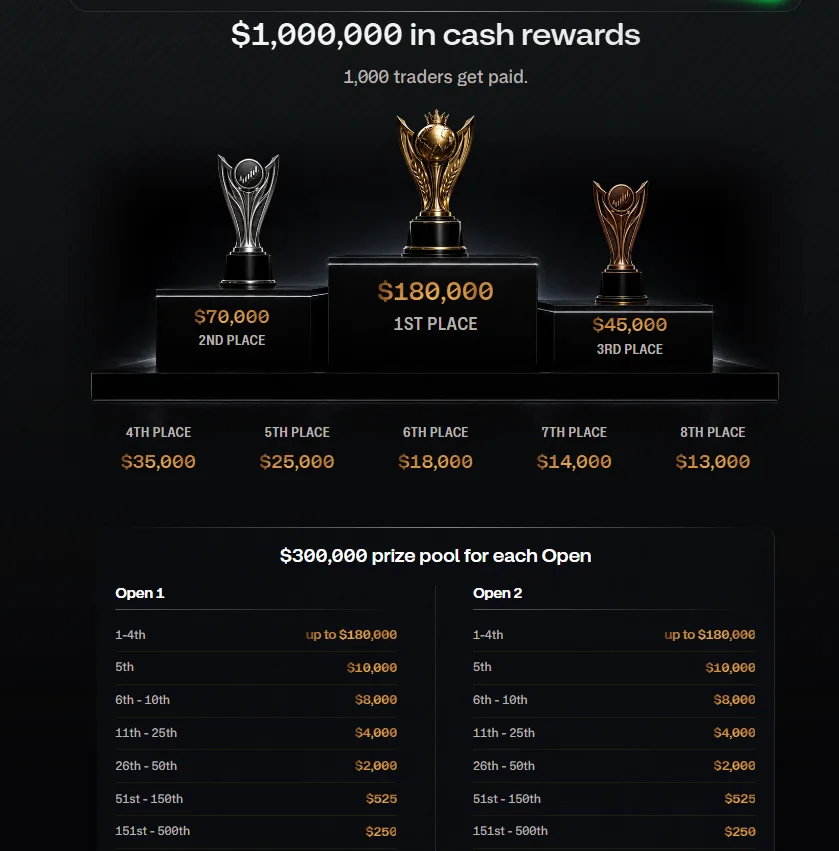
Tradeify advertises $1 million in total cash prizes. Its competition guide breaks that into $300,000 for each qualifying Open and $400,000 for the live Grand Final. The listed final prizes are real cash awards, subject to eligibility, verification, and the current rules. They are not withdrawals from the simulated trading accounts.
| Final placement | Cash prize |
|---|---|
| 1st | $180,000 |
| 2nd | $70,000 |
| 3rd | $45,000 |
| 4th | $35,000 |
| 5th | $25,000 |
| 6th | $18,000 |
| 7th | $14,000 |
| 8th | $13,000 |
The guide also lists qualifying-league awards outside the finale seats, from $250 to $10,000. The posted terms use different language about combined standings and placement, so I would not assume exactly how a league result maps to a prize without checking with Tradeify. That is still a pretty substantial incentive for a competition with free entry.
My biggest problem: the leaderboard makes you trade differently
Here's where I think Tradeify got something right and something slightly wrong. I competed in its previous Grand Cup tournament, and personally, I preferred the simpler head-to-head advancement format. Beat your opponent. Advance. Repeat. I liked that.
With the Premier Trading League, beating your opponent is only part of the equation. You also need to accumulate enough points to keep pace with the field. That changes the psychology of the competition.
I've had trading sessions where I was having a perfectly respectable day. I was profitable. I was trading well. Under normal circumstances, I probably would've called it a day and walked away happy.
But then you look at the leaderboard. Some dude at the top has apparently generated enough simulated P&L with one mini contract to make you stare at your screen a little longer. So what do I do? I keep trading. I push for more. And sometimes I give back a significant portion of what I already made in that session.
That is not Tradeify's fault. That is me making bad decisions because I'm chasing points. But I do think it is worth discussing how the competition's structure can encourage that behavior.
In a traditional head-to-head elimination tournament, your goal is to beat the person across from you. Here, beating your opponent might not feel like enough. You're also trying to keep up with the absolute psychopaths at the top of the leaderboard.
How the hell are these guys making this much with one mini?
In the leaderboard screenshot I took on October 8, the top four traders were showing roughly $26,000 to $29,000 in cumulative simulated P&L. With a maximum position size of one mini contract. One.
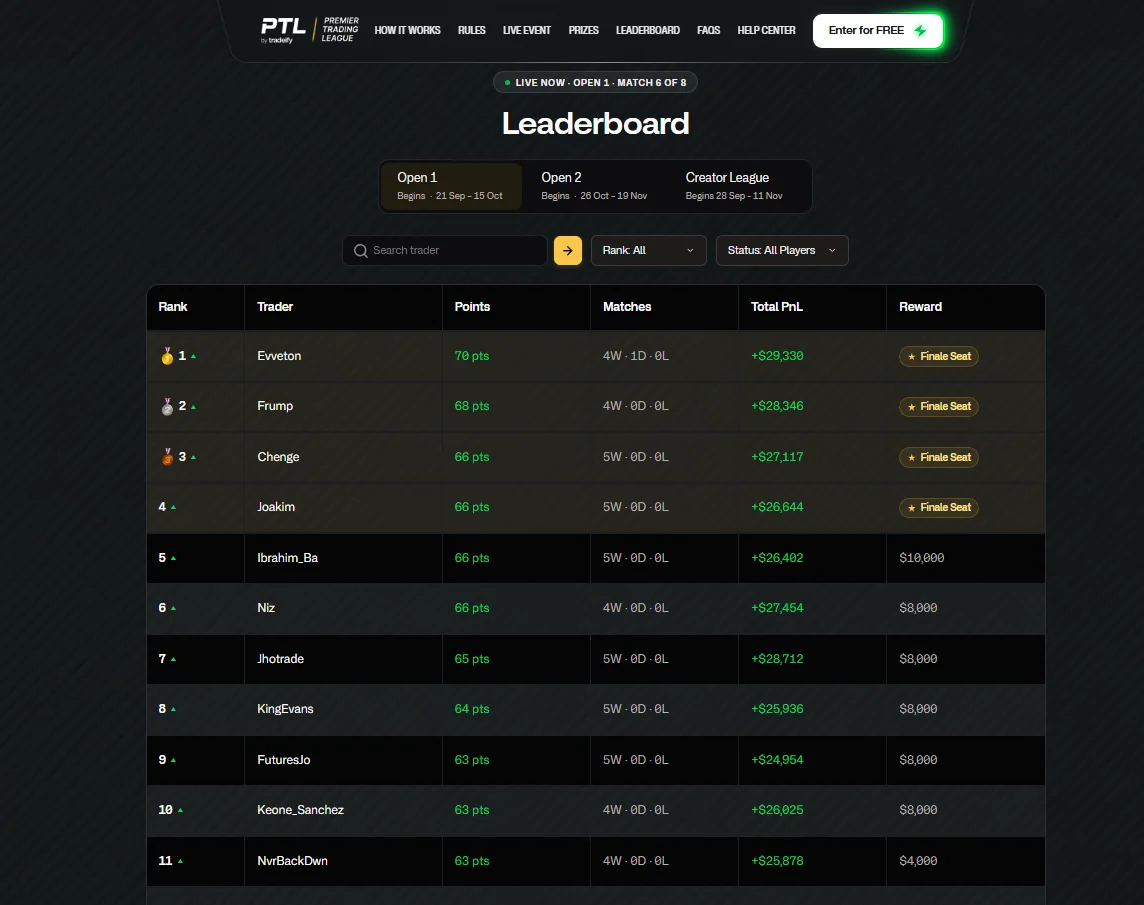
Obviously, that does not mean anyone made that number in a single trade. These traders have competed across multiple sessions and may have taken many positions. Still, the figures impressed me.
When the leaders pull away that quickly, it can be discouraging for everyone else. You can have a good trading day, win your matchup, collect points, and still feel like you are falling further behind.
I do not think the format is unfair. Everyone is playing under the same published scoring rules. I simply found the previous head-to-head advancement format more exciting because each matchup felt like its own competition. You just had to beat the person in front of you. Having competed in both formats, I think there is something to be said for that simplicity.
Is gamifying trading a bad thing?
There is a legitimate argument that turning trading into a competitive game encourages bad habits. Honestly, I understand it. Trading is hard enough without leaderboards, prize money, and the temptation to push for another $500 just to earn another point.
But I actually think competitions like this can be good for the industry, especially when entry is free. Financial markets can seem intimidating if you have never participated. Here, you sign up, get a simulated account, compete against another person, and start learning how futures markets work.
Maybe you discover something that becomes a lifelong interest. That is essentially what happened to me when I discovered trading years ago. I fell in love with the markets, and I've been obsessed ever since.
Of course, trading competitions are not the same thing as developing the discipline to trade your own money. The strategies that help you win a tournament might be terrible strategies for managing a personal trading account. Simulated P&L does not predict live results. That distinction matters.
But as an introduction to the markets? I think this is a pretty damn cool concept. If it introduces a new generation of people to trading, I'm all for it.
What about Open 2 and the Creator League?
If you missed Open 1, Tradeify's detailed competition guide lists Open 2 trading as starting October 26, with its first match on October 27 and its final match on November 19. The guide says registration closes October 25 at 11:59 PM Eastern, before trading begins.
The guide says traders may register separately for both Opens. The posted terms, though, describe Open 2 as a second chance for those who did not advance from Open 1 and refer to a combined qualifying leaderboard. I would confirm the current participation and qualification rules directly with Tradeify before relying on either description.
The guide also describes 16 creator-affiliated Companies and a separate creator division, with eight creators planned for the live event. Its description of the final does not fully match the posted terms, so treat the precise qualification structure as something to verify, not a promise from this article.
The Grand Final is scheduled for December 11 in Fort Lauderdale. As ever, read the current official rules for eligibility, registration, travel, and prize details.
My final take
I think Tradeify deserves credit for putting together something genuinely entertaining: a free simulated trading competition, a million dollars in advertised cash prizes, head-to-head matchups, and a live championship. That is a pretty compelling combination.
Do I prefer the previous Grand Cup's head-to-head elimination structure? Yeah, I think I do. Do I think the current points system can encourage traders to push harder than they normally would? Absolutely. I have personally experienced that.
But I also see value in experimenting with tournament formats and finding ways to make trading more accessible and entertaining. At the end of the day, I am still competing. I am still enjoying it. And I am still trying to figure out how the hell these guys posted about $29,000 in simulated P&L with one mini contract on that October 8 board.
If somebody figures that last part out, please let me know. Because apparently I am doing something wrong.
Sources and documents
Details can change. Review the linked sources and dated evidence alongside this report.